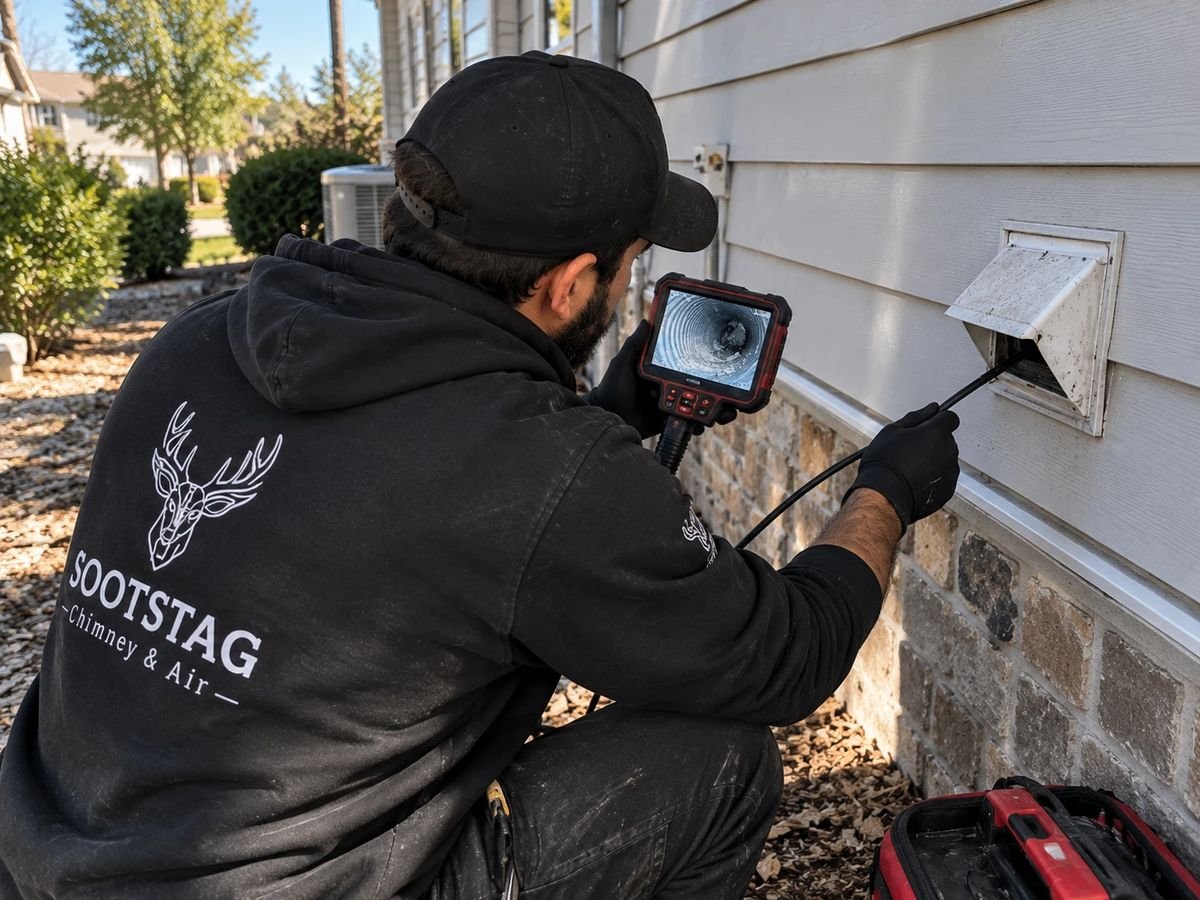
Why a Blocked Dryer Vent Becomes a Fire Risk
Lint is fuel and a dryer is a heat source. What decides whether that matters is whether the exhaust is leaving the building freely.
A dryer moves heated air through a load, picks up moisture, and pushes it out of the building.
Lint travels with it. The filter catches most of what comes off the clothes; what gets past is fine
enough to stay airborne until the air slows down, and then it settles.
That is the whole mechanism. The accumulation in a duct run is not debris that happens to be
near a heat source — it is combustible material, deposited by the appliance, inside the path the
appliance’s heat travels along.
Restriction matters more than quantity
A thin, even coating along a short straight run is not the same situation as the same weight of
lint packed at an elbow. What changes the picture is what the restriction does to the machine.
When exhaust cannot leave freely, the dryer takes longer to do the same work. Longer cycles mean
the cabinet, the duct and everything in it spend more of the day hot. Modern machines have a
thermal cutout that stops the cycle when the temperature climbs too far — which is useful, and is
also the clearest signal a household usually gets that something has changed.
What the published guidance says
Clothes dryer fires are a category that federal agencies publish guidance on. The
US
Fire Administration reports failure to clean as the leading factor contributing to the
ignition of clothes dryer fires in homes, from the national fire incident data it publishes.
Keeping lint out of the run — the duct, not just the filter — is the practical version of that
finding.
That is the useful part of the guidance, and it is where this page stops. Anyone quoting you a
probability for your particular house is guessing.
The conditions that are worth acting on
- Drying time that has changed and stayed changed
- A cycle that stops before the load is dry, more than once
- A laundry room that gets noticeably hot while the machine runs
- An exterior damper that no longer opens, or opens part way
- Lint visible around the termination or behind the machine
None of these is proof of anything on its own. Together, or persisting, they describe a run that
is not moving air the way it was installed to.
What clearing the run does, and does not do
Clearing removes the accumulation along the line, at the transition behind the machine, and at
the termination. That addresses the fuel and usually restores the airflow.
It does not shorten a run that is longer than the appliance was designed for, straighten bends
that were built in, or replace duct that was never suitable — those are conditions of the
installation, and
length and bends covers what the codes actually say
about them. A clearing that restores airflow on a run with four elbows behind a finished wall has
restored airflow on a run with four elbows behind a finished wall.
Quick answer
Why is a blocked dryer vent a fire risk?
Because the blockage is made of the fuel. Lint that gets past the filter settles along the duct, and lint burns readily. A restricted run also makes the dryer run longer and hotter to do the same work, which raises the temperature the accumulation sits at. Neither condition is dangerous on its own; together, and left for long enough, they are what the published guidance on dryer fires is about.
Common questions
Does the lint filter not catch it all?
No, and it is not meant to. The filter catches the large majority at the machine. What passes it is fine enough to stay in the airstream until the air slows down, which happens in the duct run — particularly at bends and at any point the duct is crushed or sagging.
Is a newer dryer safer in this respect?
A newer machine has better thermal cutouts, which is a protection against overheating rather than against accumulation. The cutout stopping the cycle is the machine telling you the exhaust is restricted. Treating that as an inconvenience rather than a signal is the part worth changing.
Does a metal duct remove the risk?
It removes one contributor. Smooth rigid metal gives lint less to catch on and does not crush, so it accumulates more slowly and burns nothing itself. The lint inside it is still lint. Material affects the rate, not the principle.
How do I know whether mine is restricted?
Drying time is the earliest signal and the most reliable: a load that now needs two cycles is telling you the air is not leaving properly.