
CHIMNEY INSPECTION
Assessment of the chimney structure, flue and appliance connection, with internal camera survey where access allows.
- Residential & Commercial
- Maryland and surrounding areas
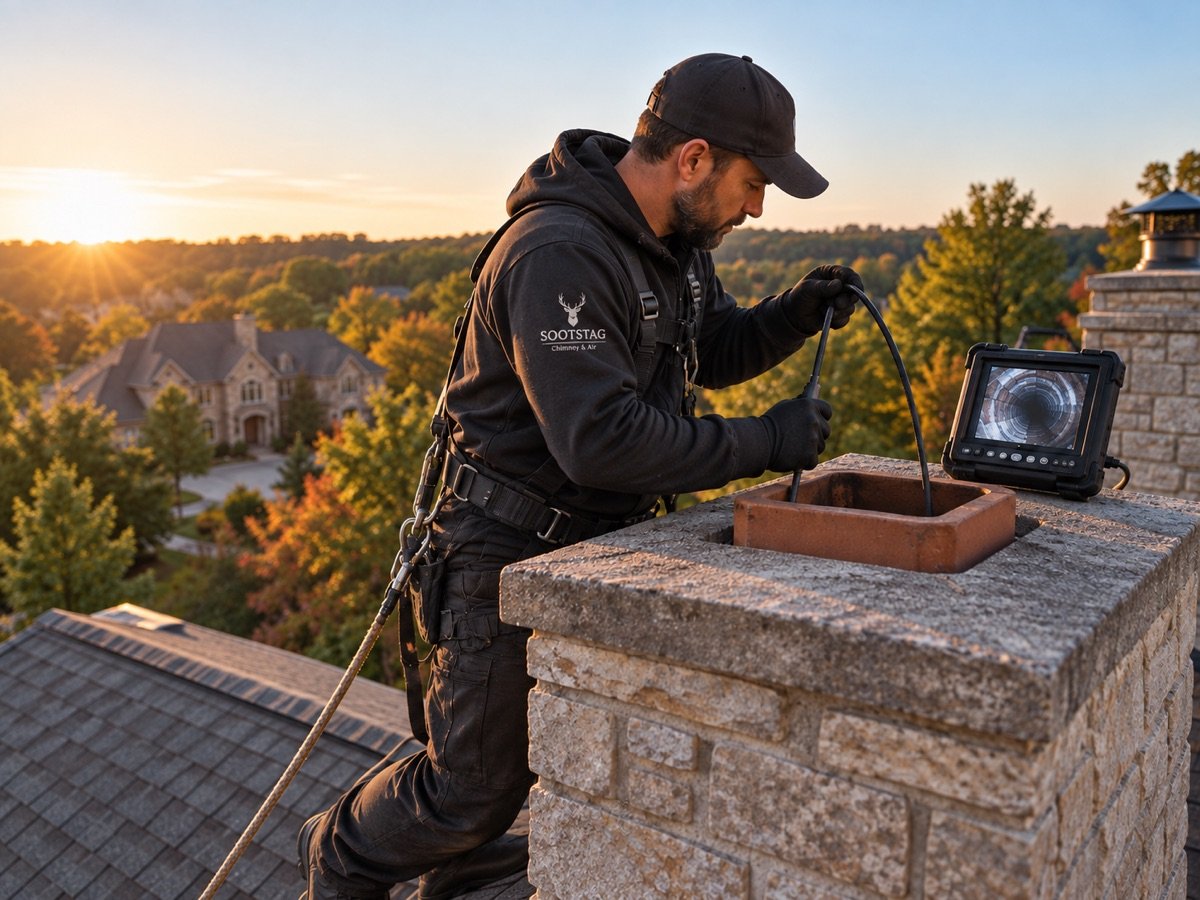
- Structure, flue and appliance connection
- Internal camera survey where access allows
- Findings reported against what was seen
WHAT CHIMNEY INSPECTION COVERS
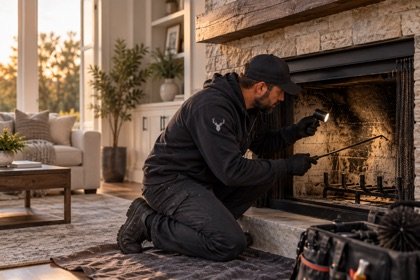
A chimney inspection is an assessment of the system rather than work on it. It covers the appliance and how it connects to the flue, the firebox and smoke chamber, the damper, the liner along as much of its length as access allows, and the exterior — the stack, the crown and the termination.
An inspection produces a description, not a cleaning. If the flue is heavily loaded, what can be reported is limited to what is visible, which is why clearing first with a chimney sweep often produces a more useful assessment. Where deposits are the known issue and the structure is not in question, the sweep on its own may be all you need.
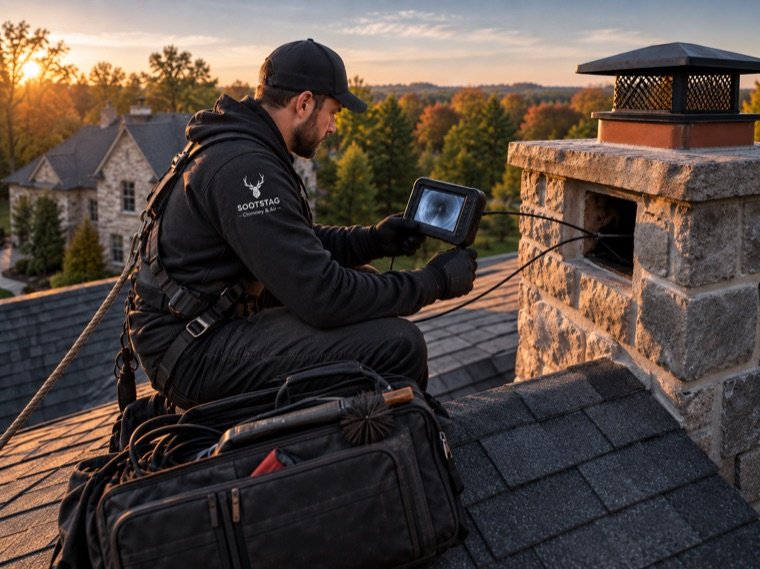
WHAT ARE YOU NOTICING?
Three of the observations that most often lead here, and what each one usually means.
Something changed
Smoke entering the room, a new smell, or staining on the stack are all reasons to look before using the appliance again.
The property is new to you
A chimney you have not used before has a history you cannot see from the firebox.
You want it on record
An inspection produces a description of the system as it stands, which is useful before work is commissioned.
WHICH ONE DO YOU NEED?
These services overlap. Here is how to tell which one answers your situation.
An inspection is the fit
- You need to know the condition before deciding anything
- Something about the system has changed
- The chimney is unfamiliar or has been unused
A sweep may be what you want
- The system is familiar and behaves normally
- You already know deposits are the issue
- The last clean was long enough ago to explain what you are seeing
WHAT THE SERVICE INCLUDES.
Every item below is part of the service. What a specific job needs is identified against the property itself.
- Visible exterior structure, crown and termination assessed
- Flue interior surveyed where access allows
- Smoke chamber, damper and firebox assessed
- Appliance connection and hearth surround assessed
- Deposit build-up and obstructions noted
Covered within this service
- Chimney Camera Inspection
- Fireplace Inspection
HOW THE WORK RUNS.
The sequence the work follows. What a particular visit needs is set by the system in front of us.
- 01 The appliance and its connection are examined Where the appliance meets the flue is the first thing looked at, because it sets what the rest of the run has been handling.
- 02 The firebox and smoke chamber are checked Surfaces, joints and the damper are assessed before anything is put into the flue.
- 03 The flue is surveyed internally where access allows A camera run covers the liner along its length rather than the section visible from the firebox.
- 04 The exterior and termination are looked at The stack, the crown and the top of the flue are part of the same system.
- 05 Findings are set out against what was seen What was observed, where in the run, and what it means for any work that follows.
HOW FINDINGS TURN INTO A DECISION
The output of an inspection is a description of the system, not a recommendation dressed as one: what was seen, where in the run it sits, and what it means for the work that might follow.
In practice most findings resolve into one of a few routes. Accumulation points at a sweep; hardened or glazed deposits at creosote removal, because brushing will not lift them; material in the run at obstruction removal. Structural findings point outside cleaning altogether. The full range sits on the chimney services page.
A legitimate outcome is that nothing warrants work. An inspection that concludes the system is sound has answered the question you asked, and that is worth as much as a scope of work.
It is the right first service when something has changed — smoke entering the room, a new smell, staining on the stack — or when the chimney is unfamiliar, as with a property you have recently taken on. The useful question is what the system is, before anything is decided about it.
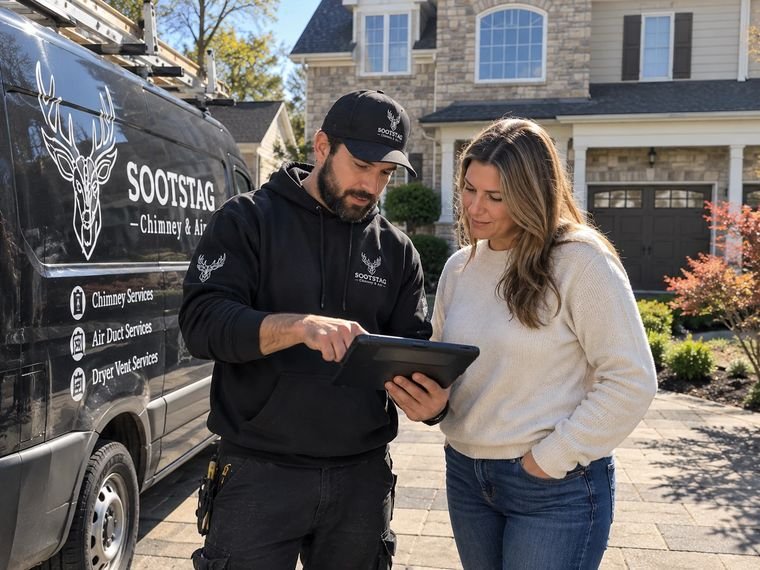
WHAT YOU ARE LEFT WITH.
The run is assessed, not guessed
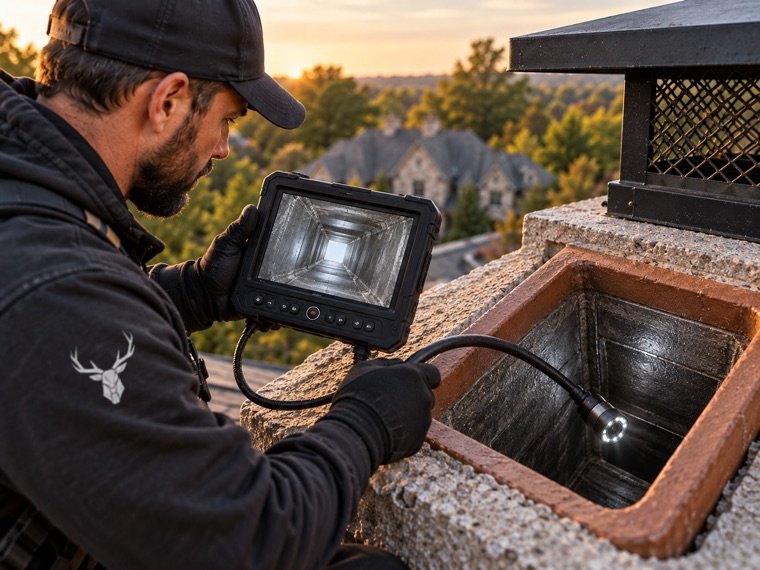
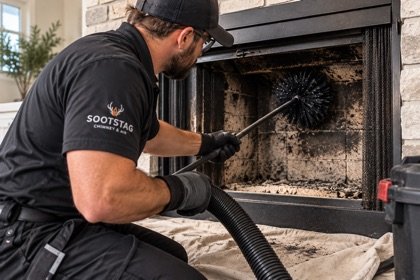
Where access allows, a camera survey covers the length of the flue rather than the part visible from below.
The connection is included
How the appliance meets the flue is part of the assessment, not a separate question.
You get a description of the system
What was seen, where, and what it means for the work that might follow.
Scope for later work becomes clear
Deciding between a sweep, a removal or work by another trade is straightforward once condition is known.
Want the chimney assessed before you decide?
Send the property and what prompted the call, and you will get a scope for the inspection.
WHAT SETS THE SCOPE.
These are the details that change what this job involves. Include what you know when you send a request — it makes the answer more useful.
Camera access
How far a survey reaches depends on the run: offsets and restrictions limit what a camera can cover.
Appliance connection
A stove connected through a register plate presents differently from an open fireplace.
Roof and termination access
Pitch, height and the state of the crown decide what can be assessed from above.
Deposit level at the time
A heavily loaded flue hides the liner. What can be reported depends on what is visible.
WHAT AN INSPECTION CAN AND CANNOT SETTLE
Where the run permits, an internal camera survey follows the liner rather than the short section visible from the firebox. A straight flue can usually be covered along its length; offsets and heavy deposits shorten what can be reached.
Within those bounds it settles a good deal — whether the liner is sound where it can be seen, how the appliance is connected, whether the damper operates, and what the deposit level actually is.
It also answers a question cleaning cannot. Moisture reaching deposits inside a run is a common source of the smells that bring people to odour work.
- REACH
- How far the camera could actually follow the run.
- CONDITION
- Liner, connection, damper and true deposit level.
- LIMITS
- Anything not reached is recorded as not reached.
WHAT TO HAVE READY.
Let the appliance go cold
A recently used flue cannot be surveyed.
Say what prompted the call
Smoke, smell, staining or a purchase — the reason shapes what gets the closest attention.
Mention any known history
Previous work, a relining, or a long period unused are all worth saying up front.
WORTH UNDERSTANDING FIRST.
Chimney Inspection Levels: What 1, 2 and 3 Actually Cover The three levels are defined in a public standard, and which one applies is decided by the circumstances rather than by what anyone would prefer to sell.
Sweep or Inspection? Which Chimney Service Fits the Situation Six different pieces of work get described as "chimney cleaning". Which one applies depends on what you have noticed, not on which is cheapest to book.
RELATED SERVICES.
The rest of the chimney family, each with its own scope.
Quick answer
What is checked during a chimney inspection?
The chimney structure, the flue along its length, and the connection between the appliance and the chimney. Where access allows, the flue is surveyed internally with a camera rather than assessed from the two ends and inferred in between. What comes back is a description of what is actually there, including the parts that could not be reached and why.
CHIMNEY INSPECTION — COMMON QUESTIONS.
If your question isn't here, send it with an estimate request and we'll answer it directly.
The appliance and its connection, the firebox and smoke chamber, the damper, the liner along as much of its length as access allows, and the exterior including the stack and crown. The chimney behaves as one system, so it is assessed as one.
Inspection, when you need to know condition before deciding anything, or when something has changed. Sweep, when the system is familiar and you already know accumulation is the issue.
As far as the run allows. A straight liner can usually be surveyed along its length; offsets, restrictions and heavy deposits limit it. The findings state how much of the run was covered rather than implying all of it was.
Often, because a loaded flue hides the liner. Where deposits are heavy enough to obscure the surface, what can be reported is limited to what is visible, and clearing first produces a more useful assessment.
Yes. A flue used within roughly the previous day cannot be surveyed, so leave it unlit ahead of the visit.
Yes. An unfamiliar chimney has a history the firebox does not show, and an inspection produces a description of the system as it stands, which is what a decision rests on.
A description of what was seen, where in the run it sits, and what it means for any work that might follow — including the case where nothing is warranted.
It reports the condition of what could be seen and the limits of that access. Where a finding sits outside cleaning — structural movement, water ingress, a compromised liner — it is described rather than resolved inside this visit.
TELL US WHAT YOU NEED.
WE'LL COME BACK WITH A SCOPE.
Send the property type and the service you're after. You'll get a clear scope and a price — no obligation to book.
- Family-Owned
- 12+ Years of Experience
- Certified & Insured
- Residential & commercial
- Maryland and surrounding areas