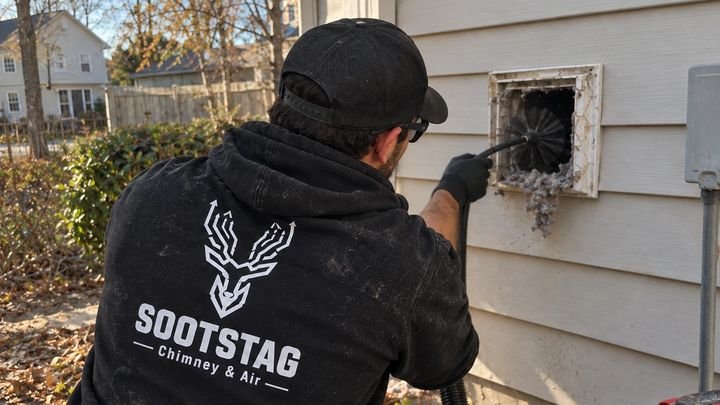
Dryer Vent Warning Signs Worth Acting On
Clothes taking longer to dry is the earliest and most reliable signal that a dryer vent is restricted. Most of the others are variations on it.
A dryer works by moving heated air through the load and carrying the moisture out of the building. Everything about its performance depends on that air actually leaving. When it cannot, the machine keeps running and the results get worse — which is why the symptoms show up as performance problems long before anything more obvious.
The US Fire Administration publishes guidance on clothes dryer fire safety, and failure to clean is the leading factor it identifies. The practical version of that advice is: notice the airflow, and act when it changes.
The signal that matters most
Clothes taking longer to dry than they used to. Not longer than the manual says, and not longer than a neighbour’s dryer — longer than your dryer used to take for the same kind of load. A cycle that now needs repeating is the clearest early evidence that the air is not moving as it should.
This matters more than the others because it appears first, and because it appears gradually. Lint accumulates slowly. Most people adjust to a dryer that needs a bit longer without registering that anything has changed, until the change is large.
The other signs, and what each one means
The laundry room gets hot
Heat that should be leaving the building through the duct is staying in the room instead. It is the same restriction, felt rather than measured.
The room feels humid, or there is condensation
A dryer removes a substantial amount of water from a load. If the room is damp when the dryer runs, that moisture is not making it outside.
A burning or scorched smell
This one deserves immediate attention rather than a note for later. Stop using the dryer until the run has been checked.
The exterior damper does not open
Go outside while the dryer is running and look at the termination. The flap should be open with air moving through it. A damper that stays shut, opens weakly, or is visibly packed with lint is direct evidence of a restriction — and it is the single most useful check a homeowner can make without tools.
Lint around the machine or the termination
Lint escaping at either end suggests it is not travelling the route it should.
Why the duct run matters more than the machine
The lint filter catches a large share of what comes off a load, and emptying it is worth doing every cycle. What it does not do is reach anything past itself. Lint that gets by the filter settles along the duct behind the dryer, and it settles fastest where the air slows down — at bends, at joints, at crushed sections behind the machine, and at the termination.
That means two runs of identical length can be in quite different condition depending on how many turns they take and what they are made of. A long run with several elbows accumulates faster than a short straight one. Flexible foil or plastic duct traps more than rigid metal, and is easier to crush behind a machine that has been pushed back against the wall.
What you can check yourself
- Clean the lint filter before every load, and wash it occasionally if you use dryer sheets, which can leave a film that restricts airflow through the mesh.
- Look behind the dryer. A duct that is kinked, crushed or disconnected is a common and fixable problem.
- Watch the exterior damper while the machine runs.
- Note how long a typical load actually takes, so that you have something to compare against later.
What cleaning the run involves
The work is the duct between the machine and the outside, cleaned along its length rather than only at the ends, with the lint collected rather than pushed through. If the termination has been colonised, that is a separate job — a nest is a solid obstruction, and removing it is different work from clearing accumulated lint.
Where the symptoms are ambiguous, or where the run is long, concealed or shared in a multi-unit building, an inspection establishes what the run actually looks like before anyone commits to a scope. Otherwise, dryer vent cleaning addresses the accumulation directly.
Quick answer
What are the warning signs of a blocked dryer vent?
The clearest early sign is drying time: a load that now needs two cycles where it used to need one. A hot or humid laundry room, lint around the machine, and an exterior damper that no longer opens properly are the same restriction showing itself differently. A burning smell means stop using the dryer until the run has been checked.
Common questions
Is cleaning the lint filter enough?
No. The filter catches a large share of lint, but what passes it accumulates in the duct run behind the machine, which the filter cannot reach.
How long should a dryer take?
There is no universal figure — loads and machines differ. What matters is the change: a dryer that now takes noticeably longer than it used to for the same kind of load.
Does a longer vent run make a difference?
Considerably. Length, bends and the material of the duct all affect how easily air moves, and how readily lint settles.
What about a bird nest in the vent?
Terminations are an attractive nesting site, and a nest is a hard blockage rather than a gradual restriction. It usually shows up as a sudden change rather than a slow one.