Duct Cleaning After Building Work: Why Construction Dust Is Different
Ordinary household dust and the dust from cutting, sanding and demolition behave differently inside a duct system, which is why one is a maintenance question and the other is not.
Most questions about duct cleaning are questions about whether it is necessary. This one is not,
and the reason is worth understanding rather than taking on trust.
Construction dust is a different material
Household dust is largely fibres, skin cells and soil tracked in from outside. It is relatively
coarse and it settles. Cutting drywall, sanding joint compound, breaking up plaster and cutting
masonry produce fine mineral particulate — much smaller, much lighter, and produced continuously
while the work is happening.
Fine particulate stays airborne longer, travels further, and settles into places coarser dust never
reaches. That is why it turns up on a windowsill two floors from the work.
A running system is a distribution network
A forced-air system’s return side is, by design, pulling air out of the house. If that air is
carrying construction dust, the dust goes where the air goes: through the return runs, through the
filter, into the equipment cabinet, past the blower, and out through every supply branch in the
building.
This is the part that surprises people. The dust does not stay near the renovation. We routinely
find it in branches serving rooms the builders never entered, on a floor they never worked on.
The filter does not solve it
A filter catches a proportion of what passes it, and construction dust is finer than what a typical
filter is rated to hold. It is also produced in enough quantity to load a filter quickly, and a
loaded filter passes more, not less.
Why it is scoped as its own service
Post-construction cleaning is
separated from routine duct cleaning because the loading is
different and so is the method. The system is cleaned from the equipment outward rather than room by
room, so dust is not pushed ahead of the work into branches that have already been done, and the
equipment cabinet and blower compartment are part of the job rather than an add-on.
It also usually means more of the system is in scope. Routine cleaning can reasonably be argued
about branch by branch. After building work the question is not which runs are affected.
When to do it
After the dust stops being made. That means after sanding and finishing, not after the structural
work — a system cleaned mid-project is a system that will need cleaning again. If the renovation runs
in phases, cleaning after the last dusty phase is the only version that stays clean.
How to tell whether it is worth doing
Take a register grille off and look inside with a torch. Settled grey dust in an even layer is
ordinary. A pale, powdery film that is clearly not household dust — or visible drifts of it — is
construction dust, and it is the same test described in
how to tell if your ducts actually need
cleaning. What that article says about not cleaning ducts on a schedule still holds. This is the
specific circumstance it was distinguishing from.
Quick answer
Do I need my ducts cleaned after a renovation?
If the heating or cooling system ran during the work, almost certainly. Construction produces fine mineral dust from cutting, sanding and demolition in quantities ordinary household activity does not, and an operating system pulls it into the return side and distributes it through branches well away from the work itself. It is scoped as its own service because the loading is different from routine accumulation.
Common questions
We sealed the room off. Is that enough?
It helps at the source but it does not close the system. Returns elsewhere in the house keep pulling air, and dust travels further through a building than the plastic sheeting suggests.
Should the work happen before or after the decorating?
After. Sanding and finishing produce as much fine dust as the structural work, and cleaning a system before the dust has finished being made is cleaning it twice.
Does the furnace need attention too?
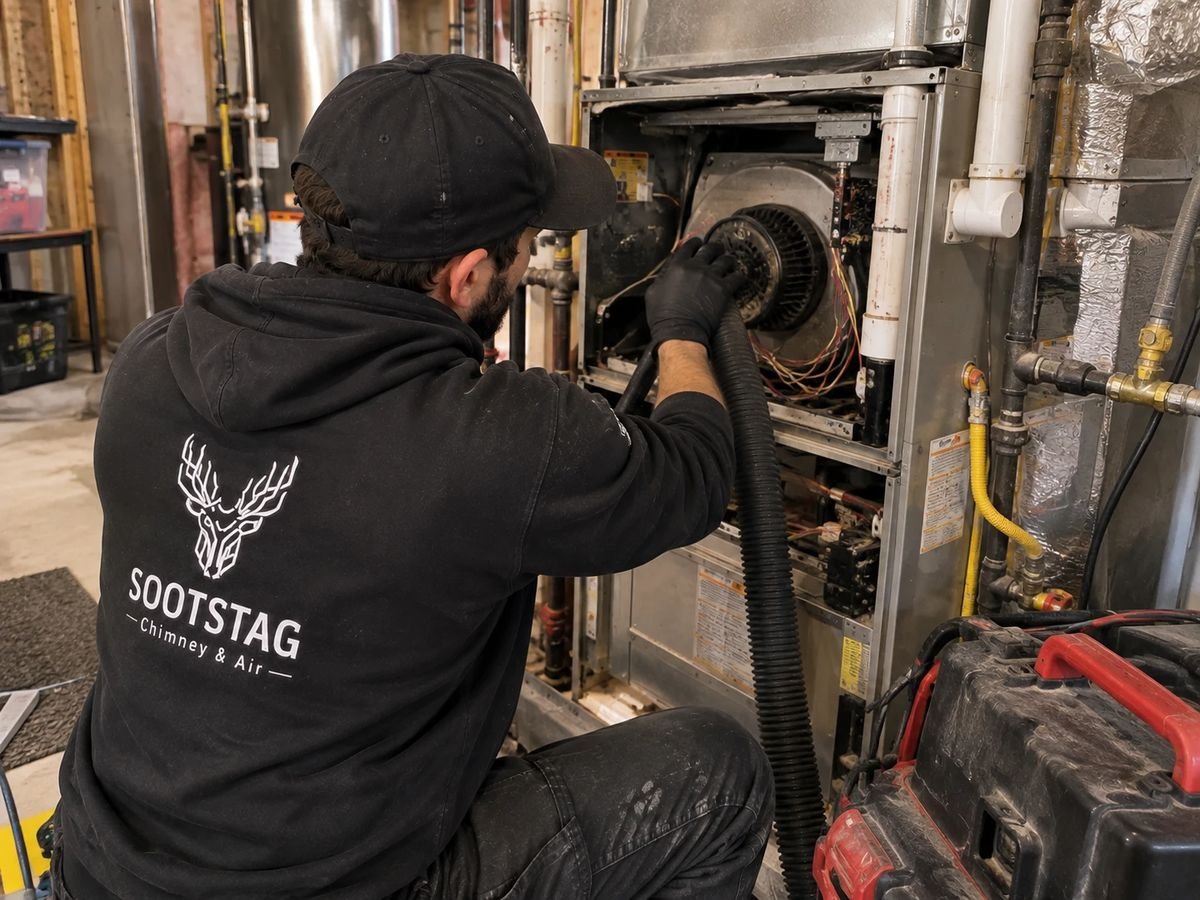
Usually. The blower compartment sits on the return side and is where a lot of what the system pulled in ends up — that is furnace cleaning, and it is a different service from the ducts.
What if the system was switched off throughout?
Then far less has been drawn in, and the honest answer may be that it does not need doing. An inspection settles it by looking rather than assuming.