How Often Should a Chimney Be Swept?
The honest answer is that sweeping runs on deposits, not on the calendar — but the inspection that tells you which you need does run annually.
There is no single interval that is correct for every chimney, and any answer that starts with a number before it asks a question is guessing. What a chimney needs depends on what you burn, how you burn it, and what the flue looks like inside right now.
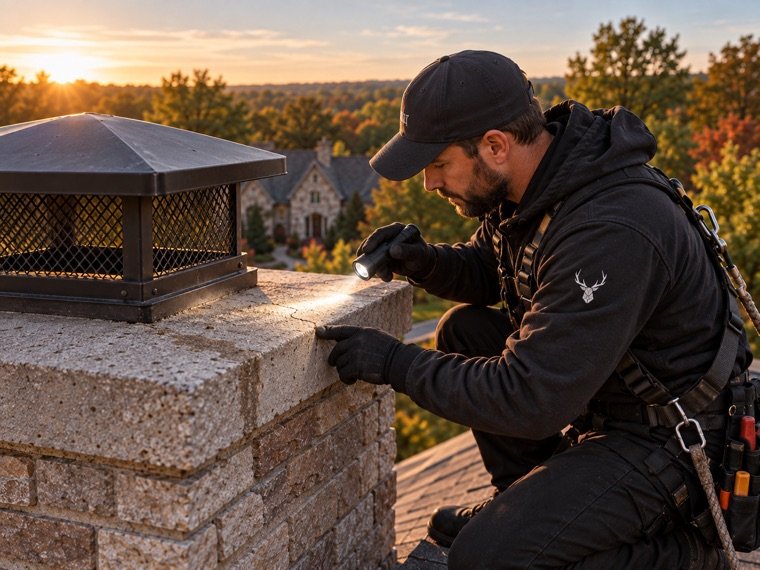
What is fixed is the inspection. The National Fire Protection Association’s standard for chimneys and vents, NFPA 211, calls for chimneys, fireplaces and vents to be inspected annually. Sweeping is what happens when that inspection finds enough deposit to warrant it.
What actually drives how often a chimney needs sweeping
Four things do most of the work, and none of them is the date.
How much you burn
A fireplace lit on a dozen winter evenings and one burning most nights from November to March are not the same chimney with the same needs. Deposit accumulates with use, so usage is the first variable anyone should ask about.
What you burn
Unseasoned or wet wood burns cooler and smokier, and cooler smoke condenses more readily on the flue wall. Dry, well-seasoned hardwood burned in a hot fire leaves markedly less behind than damp softwood smouldering overnight.
How the appliance runs
An open fireplace, an insert and a wood stove move air through the flue differently. A stove damped down to burn slowly overnight is the classic recipe for heavy deposit, because a slow, oxygen-starved fire produces exactly the cool, particle-laden smoke that coats a liner.
The condition of the flue itself
A rough, deteriorating or already-coated liner catches more than a clean one. Moisture entering through a cracked crown changes what the deposit does once it lands. This is the part a homeowner cannot assess from the hearth, and it is the main argument for looking rather than scheduling.
Why the deposit type matters more than the amount
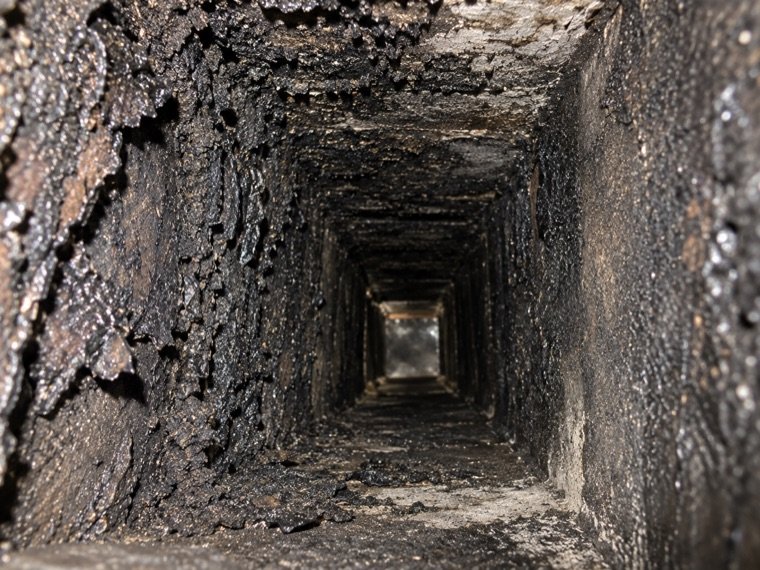
Not all buildup behaves the same way. Light, flaky soot brushes away readily. Deposit that has been repeatedly heated and cooled can harden into a dense, tar-like layer that a standard brush pass will not shift, and which needs different tools entirely — that is the distinction between a routine chimney sweep and creosote removal.
This is why “how often” is the wrong first question. Two chimneys with the same quantity of deposit can need quite different work depending on what state that deposit is in.
Signs that you should not wait for the annual inspection
Several things are worth acting on when you notice them rather than at the next scheduled visit:
- Smoke entering the room when the fire is drawing normally, or a fire that is suddenly hard to establish
- A strong smell from the fireplace, particularly in warm or humid weather
- Visible debris, nesting material or dark flakes falling into the firebox
- Staining on the masonry around or above the fireplace
- Birds, or the sound of animals, in the chimney
A change in how the chimney draws is the signal most worth taking seriously, because draught is the thing that a restriction affects first. If something has changed, the useful next step is an inspection that establishes what the flue looks like, rather than booking a sweep and hoping that was the problem.
What a sweep actually covers
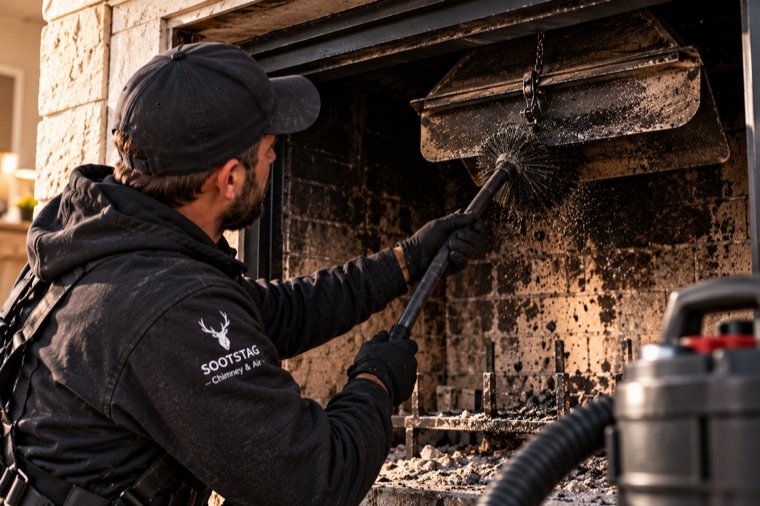
A sweep is mechanical removal along the accessible length of the flue, plus the smoke chamber, the smoke shelf, the firebox and the damper area. Loose material is collected and taken away. What it is not is an assessment of the structure carrying that deposit — a swept flue is simply the only state in which a liner can properly be seen, which is why sweeping and inspection so often belong in the same visit.
A reasonable way to decide
Have the chimney inspected once a year, before the heating season rather than during it. Let that inspection decide whether it needs sweeping now, and act immediately on any change in how the fire draws or smells. That approach costs less over time than a fixed schedule, because it neither pays for work that is not needed nor waits twelve months to find work that is.
Quick answer
How often should a chimney be swept?
There is no single correct interval. Have the chimney inspected once a year, and swept whenever that inspection finds enough deposit to justify it. How fast deposit builds depends on how much you burn, what you burn, and how the appliance runs — a stove damped down overnight produces far more than an open fire on dry hardwood.
Common questions
Is once a year the right answer for everyone?
Once a year is the right answer for inspection. Sweeping depends on what the inspection finds — some chimneys need it more than annually, others less.
Does a gas fireplace need sweeping?
A gas appliance produces very little solid deposit, but its flue still needs to be checked. Blockages, moisture damage and failed liner joints are not fuel-specific.
Can I tell from the fireplace whether the flue needs work?
Only partly. The firebox and the visible throat tell you something, but the length of the flue above them is where deposits accumulate, and that needs a light and usually a camera.
Does burning hotter fires mean I never need a sweep?
Hot, dry fires produce less creosote than smouldering ones, which genuinely reduces buildup. It does not eliminate it, and it does nothing about nesting material, debris or a deteriorating liner.