Sweep or Inspection? Which Chimney Service Fits the Situation
Six different pieces of work get described as "chimney cleaning". Which one applies depends on what you have noticed, not on which is cheapest to book.
“Chimney cleaning” is used to mean at least six different pieces of work. Booking the wrong one
is rarely expensive, but it is frustrating: the job is done properly and the thing that prompted
the call is still there.
The reliable way through it is to start from what you actually noticed.
Start from the symptom
Nothing is wrong, and nothing has changed
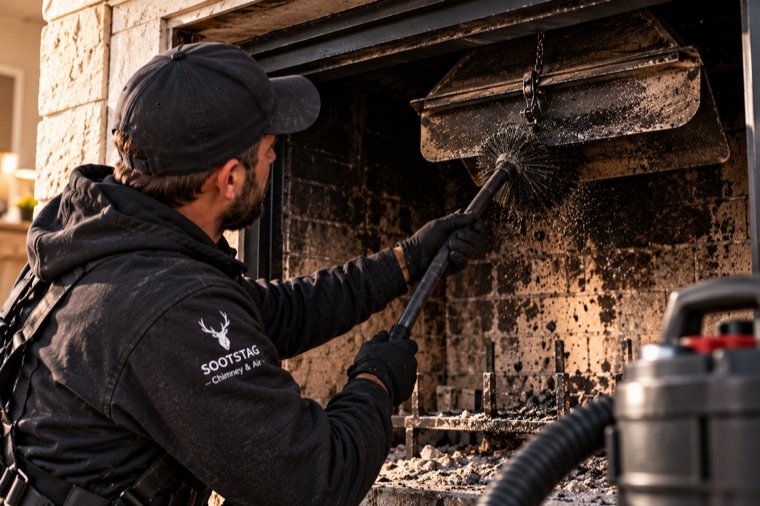
Routine maintenance on an appliance you know, burning what you have always burnt. That is
a sweep: the flue, the smoke chamber, the firebox and
the damper area. How often is a separate question, and
it has its own answer.
Something has changed, or you do not know the history
A different appliance or fuel, an insert added, a house you have just bought, or an event that
could have affected the structure. Here the useful first step is
an assessment rather than a clean, for a
practical reason: a flue coated in deposit cannot be judged, because the deposit is what you would
be looking at. What the different levels of assessment cover is
explained separately.
The deposit will not come off
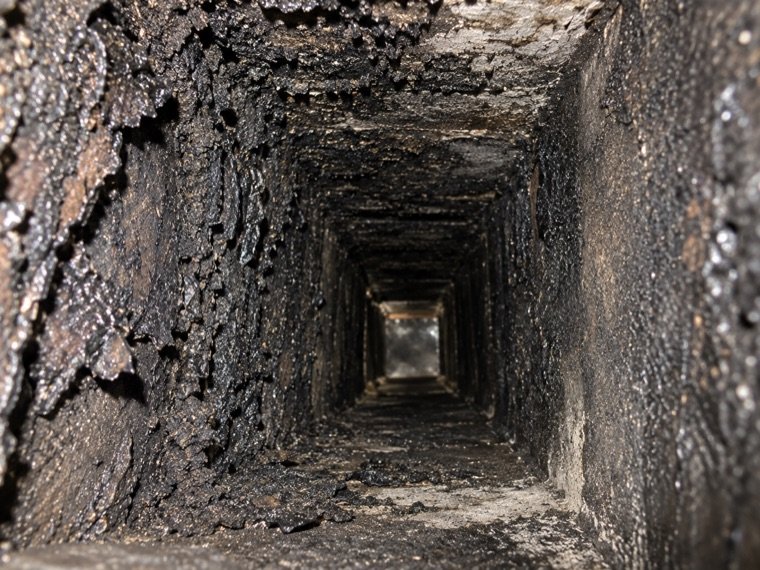
A hard, shiny, tar-like layer is a different material from loose flake, and a routine brush pass
does not lift it. That is
creosote removal, and
why the type matters more than the amount explains how it
gets there.
The firebox looks neglected but the flue is fine
Grate, damper plate, hearth and surround — the assembly you look at rather than the run above it.
That is fireplace cleaning, and it is listed
separately from sweeping precisely because they are scoped differently.
There is a smell, and no fire lit
An odour needs a source and a route, and treating one without the other does not hold.
Odour work starts by establishing which it is;
why a cold chimney smells covers the mechanism.
You can hear something, or the flue is obstructed
Nesting material and leaf litter are an obstruction rather than an accumulation, and they
come out as their own job —
animal and nest removal. Timing matters
and some birds are protected:
what to do, and what not to.
When two of them apply
They frequently do, and the order is usually the same: whatever establishes the condition comes
before whatever changes it. Deposit is removed so the flue can be seen; an obstruction comes out
before anything else is meaningful; a smell is traced before it is treated.
That is also why a scope written against your property is more useful than a service name chosen
in advance. Describe what you have noticed — the smell, the noise, the change, the purchase — and
the answer to “which of these is it” comes back with the scope.
Quick answer
Do I need a chimney sweep or a chimney inspection?
If nothing about the appliance or its use has changed and you are maintaining a chimney you know, a sweep is the routine answer. If something has changed — a different appliance or fuel, a property purchase, an event that could have damaged the chimney — or you do not know the flue's history, the assessment comes first, because deposit is what an inspection would otherwise be looking at.
Common questions
If I book a sweep, will I be told what else is wrong?
Observations made during a sweep are reported, but a sweep is not an assessment and should not be sold as one. If the question you actually have is about the condition of the flue, that is the job to book.
Can a sweep and an assessment happen in the same visit?
Often, and in that order. Removing the deposit is what makes the flue assessable, so the two sit naturally together where both are needed.
I have not used the fireplace for years. Where does that leave me?
Closer to the assessment end. Disuse does not clean a flue, and it adds its own possibilities: moisture, nesting material and deterioration that nobody has looked at.
What if more than one of these fits?
That is common, and it is not a problem. Tell us everything you have noticed and the scope comes back written against the property rather than against a category.